
Official Motus K53 learners & Drivers Test
1: The Test Chart
• Instead of full letters, you’ll see a block shaped letter “E” in different orientations:
• Facing upwards (↑)
• Facing downwards (↓)
• Facing Left (←)
• Facing Right (→)

2: The Task
• You don’t have to name letters.
• You simply tell the examiner which way the “legs of the E” are pointing.
• Example: “Up”, “Down”, “Left”, “Right”.
3: The Procedure
• You’ll place your chin on a rest or look into a vision screener (a machine at the counter).
• Each eye is tested separately, then both together.
• The examiner flips through different lenses/settings to check your vision clarity.
4: What They’re Checking
• Visual acuity (sharpness of sight) – can you see the smallest “E” symbols?
• Peripheral vision – sometimes you’ll be asked to press a button or say when you see a light flicker on the sides.
• Depth & balance (in some machines) – checks if your eyes work together properly.
5: Pass Requirement
• You need at least 6/12 vision in one eye, or both eyes together, with or without glasses/contact lenses.
• If you need glasses to pass, it will be marked on your licence as a restriction.
So, the thing to remember is the forward and backward “E’s” are part of the eye test, along with “up” and “down” variations.
Do I have to take the eye test at the DLTC or can I bring a certificate?
Yes, absolutely you can bring a certificate, with this condition:
“The certificate must generally be no older than 3 months (90 days) on the day you apply for your learner’s or driver’s licence”
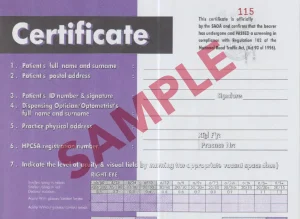
If it’s older than that, the DLTC will usually require you to redo the eye test on-site.